


By Mesfin Yimam, DVM, MS., Director, Pre-Clinical Research
How Maizinol® Works: Enhancing Your Body’s Natural Sleep Pathways

Maizinol® is a standardized corn leaf extract with two clinical trials demonstrating benefits including increased total sleep time, REM sleep time, and NREM (especially deep sleep) time, along with shortened sleep latency, reduced sleep interruptions, and improved sleep efficiency and quality.
Maizinol® supports the body’s natural production of melatonin and serotonin by enhancing specific tryptophan metabolic pathways.
Increasing the availability of tryptophan is one of the most effective ways to enhance the production of serotonin and melatonin. Tryptophan, an essential amino acid obtained through diet or supplements, serves as the precursor for both serotonin and melatonin. It is primarily metabolized through two pathways: the serotonin-melatonin synthesis pathway and the kynurenine pathway. While only about 1-2% of dietary tryptophan is used in the serotonin-melatonin pathway, approximately 95% is degraded via the kynurenine pathway.1
Tryptophan dioxygenase (TDO), primarily found in the liver, catalyzes the initial and rate-limiting step of the kynurenine pathway, the dominant route of tryptophan metabolism. TDO activity is influenced by hormones such as cortisol, which upregulates TDO and accelerates tryptophan breakdown. Therefore, reducing cortisol levels helps preserve tryptophan, making more available for serotonin and melatonin synthesis.2,3 Maizinol® has been clinically shown to reduce cortisol levels.4
Maizinol® promotes melatonin and serotonin synthesis by stimulating two rate-limiting enzymes: tryptophan hydroxylase and N-acetyltransferase.5,6
The role of Maizinol® in serotonin and melatonin synthesis was evaluated in a preclinical model following oral administration at doses equivalent to extrapolated human intakes of 250 mg and 500 mg per day. Treatment led to dose-dependent increases in brain levels of both serotonin and melatonin, along with upregulation of their respective receptors, including melatonin receptors MT1 and MT2 and the serotonin receptor 5-HT1A, at the gene expression level. These results were further supported by increased protein expression of the same receptors, confirmed via western blot analysis.7
Since the physiological effects of melatonin on sleep are mediated through activation of MT1 and MT2 receptors, Maizinol® was also tested for receptor-binding activity in cellular assays. Although its binding affinity was relatively modest, Maizinol® showed concentration-dependent binding to both MT1 and MT2 receptors, with a fourfold higher affinity for MT2.4 This supports the in vivo findings and suggests that Maizinol®’s receptor-binding effects may be attributed to its structural similarity to melatonin, potentially contributing to melatonin-like effects in the body.
The significant dose-dependent increase in melatonin and serotonin synthesis, along with mild receptor-binding activity, suggests that Maizinol®’s primary mechanism for improving sleep quality likely comes from activation of the body’s natural melatonin biosynthesis pathways. This may explain why Maizinol® does not act as a chronobiotic like melatonin itself. Improper timing of Maizinol® consumption is unlikely to shift the biological clock (either delaying or advancing it), because the rate-limiting enzyme N-acetyltransferase, responsible for converting serotonin to melatonin, is deactivated by daylight.8 As a result, Maizinol®’s effects are concentrated mainly on serotonin synthesis during daylight exposure, limiting melatonin production to the appropriate circadian window.
The mood-enhancing effects of Maizinol® (possibly through healthy levels of serotonin production) have been previously reported in an active comparator clinical trial. Participants with mild depression and anxiety who received 250 mg of Maizinol® once daily in the morning for 8 weeks experienced statistically significant improvements in mood states.9
Collectively, these mechanisms of action, including stimulation of rate-limiting enzymes, inhibition of tryptophan breakdown, and structural similarity to melatonin enabling binding to melatonin receptors,10 may result in additive or synergistic effects. These contribute to Maizinol®’s unique role as a melatonin enabler, supporting improvements in sleep quality parameters. These effects have been validated through multiple clinical studies, including those using the gold standard of sleep assessment with polysomnography.
Melatonin and Other Sleep Aids vs. Maizinol®: A Clear Distinction in Sleep Support

Melatonin supplements can override the body’s natural rhythm, potentially disrupting the biological clock when taken at the wrong time. Improper timing can lead to “phase shifting,” where the internal circadian rhythm is either delayed or advanced.11 As a hormone, exogenous melatonin may also cause hormonal imbalances. Common side effects include morning grogginess or brain fog, and with prolonged use, some individuals may develop tolerance or dependence.
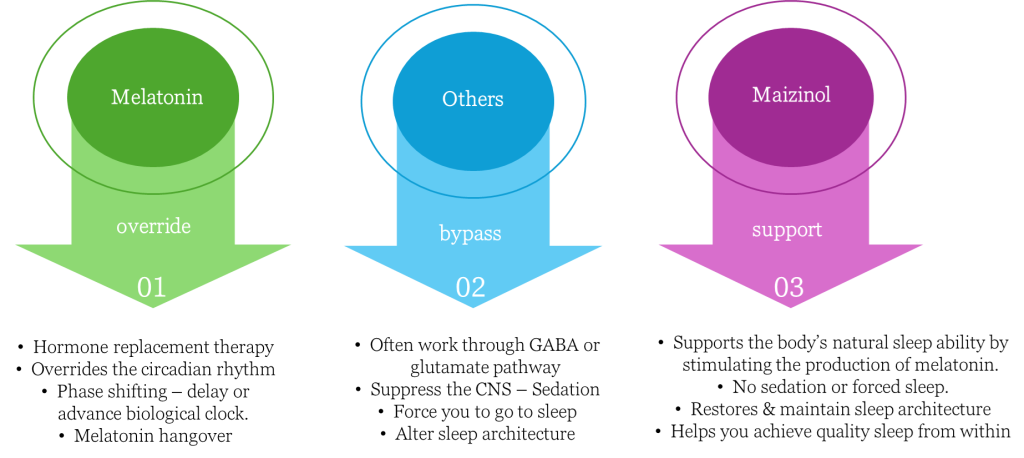
Other traditional sleep aids often act through GABA and function by bypassing the circadian system altogether, acting as central nervous system (CNS) suppressants or sedatives.12 These substances force the body into sleep, which may alter natural sleep architecture and lead to inconsistent effectiveness. Over time, users may experience cognitive impairment, tolerance, and dependency.
In contrast, Maizinol® offers a new, hormone-free approach to sleep support. It does not sedate or force sleep, nor does it disrupt hormonal balance. Instead, Maizinol® works by stimulating the body to increase its own natural melatonin production, replenishing the age-related deficit and helping users fall asleep in sync with their biological rhythm while preserving sleep architecture. This natural action promotes not a quick fix, but a sustainable, long-term improvement in sleep quality.
Maizinol® is free from the common drawbacks associated with traditional sleep aids. It does not cause morning grogginess, cognitive impairment, tolerance, or dependency. By supporting the body’s own sleep mechanisms, Maizinol® helps restore the natural sleep rhythm, enabling users to achieve deep, restorative sleep from within.
Advancing Sleep Health: The Need for Smarter, Multi-Pathway Supplementation

The global sleep crisis is driving significant growth in the market for sleep-support supplements, as more consumers seek natural, non-pharmaceutical solutions. Despite this rising demand, innovation in the category has largely stagnated. Most products rely on “stacked” formulations that combine familiar ingredients such as valerian root, GABA, theanine, lavender, chamomile, lemon balm, saffron, and magnesium. Melatonin remains the most widely used ingredient, yet its role is often misunderstood.
Although melatonin is commonly found on supplement shelves alongside vitamins and minerals, it is not a nutrient but a hormone. Exogenous melatonin should be considered a form of hormone replacement therapy intended to restore nighttime melatonin levels typical of younger individuals. When taken at physiological doses and timed appropriately, melatonin can benefit those with insufficient natural production at bedtime. It currently accounts for approximately 58% of the sleep supplement market. As a natural alternative to synthetic melatonin, Maizinol® can be administered as a standalone active or in combination with a physiological dose (0.5-1 mg) of melatonin for sleep support, especially in senior populations.
Sleep disorders affect individuals across all age groups. Although the ability to fall asleep becomes more difficult with age, the need for quality sleep does not change. While older adults often experience reduced melatonin production due to progressive calcification of pinealocytes in the pineal gland, younger adults are increasingly impacted by lifestyle factors such as excessive screen time, chronic stress, and anxiety. This broad spectrum of causes presents both a challenge and an opportunity for product developers to create solutions that address diverse needs.
Anxiolytic ingredients are well suited for managing stress and anxiety. The inclusion of Maizinol® at an effective dosage (250 mg) alongside these ingredients offers a promising approach to support natural sleep mechanisms. Maizinol® is water soluble and stable in acidic environments, making it highly compatible for formulation with other ingredients across various delivery formats.
References
- Haq S, Grondin JA, Khan WI. Tryptophan-derived serotonin-kynurenine balance in immune activation and intestinal inflammation. FASEB J. 2021 Oct;35(10):e21888.
- Badawy AA. Tryptophan: the key to boosting brain serotonin synthesis in depressive illness. J Psychopharmacol. 2013 Oct;27(10):878-93
- Silber BY, Schmitt JA. Effects of tryptophan loading on human cognition, mood, and sleep. Neurosci Biobehav Rev. 2010 Mar;34(3):387-407
- Talbott SM, Talbott JA, Brownell L, Yimam M. UP165, A Standardized Corn Leaf Extract for Improving Sleep Quality and Mood State. J Med Food. 2023 Jan;26(1):59-67
- Tanda SE. The effect of 6-methoxy-2-benzoxazolinone (6-mboa) on indoleamine regulation and its possible role in depression. Master of science thesis. Faculty of Science Rhodes University, January 2000
- Yuwiler A, Winters WD. Effects of 6-methoxy-2-benzoxazolinone on the pineal melatonin generating system. J Pharmacol Exp Ther. 1985 Apr;233(1):45-50
- Kim HJ, Kim H, Kim YJ, Do SG, et al. UP165, standardized corn leaf extract and its active component 6-methoxybenzoxazolinone induce non-rapid eye movement sleep through melatonergic and GABAergic mechanisms, Food Bio. 2024, Volume 61. https://doi.org/10.1016/j.fbio.2024.104584.
- Gastel JA, Roseboom PH, Rinaldi PA, Weller JL, Klein DC. Melatonin production: proteasomal proteolysis in serotonin N-acetyltransferase regulation. Science. 1998 Feb 27;279(5355):1358-60
- Kalman DS, Feldman S, Vazquez RR, Krieger DR. A Prospective Randomized Double-Blind Study Evaluating UP165 and S-Adenosyl-l-Methionine on Depression, Anxiety and Psychological Well-Being. Foods. 2015 May 8;4(2):130-139.
- Sweat FW, Berger PJ. Uterotropic 6-methoxybenzoxazolinone is an adrenergic agonist and a melatonin analog. Mol Cell Endocrinol. 1988 May;57(1-2):131-8.
- Lewy AJ, Sack RL. Exogenous melatonin’s phase-shifting effects on the endogenous melatonin profile in sighted humans: a brief review and critique of the literature. J Biol Rhythms. 1997 Dec;12(6):588-94.
- Brohan J, Goudra BG. The Role of GABA Receptor Agonists in Anesthesia and Sedation. CNS Drugs. 2017 Oct;31(10):845-856. doi: 10.1007/s40263-017-0463-7.